




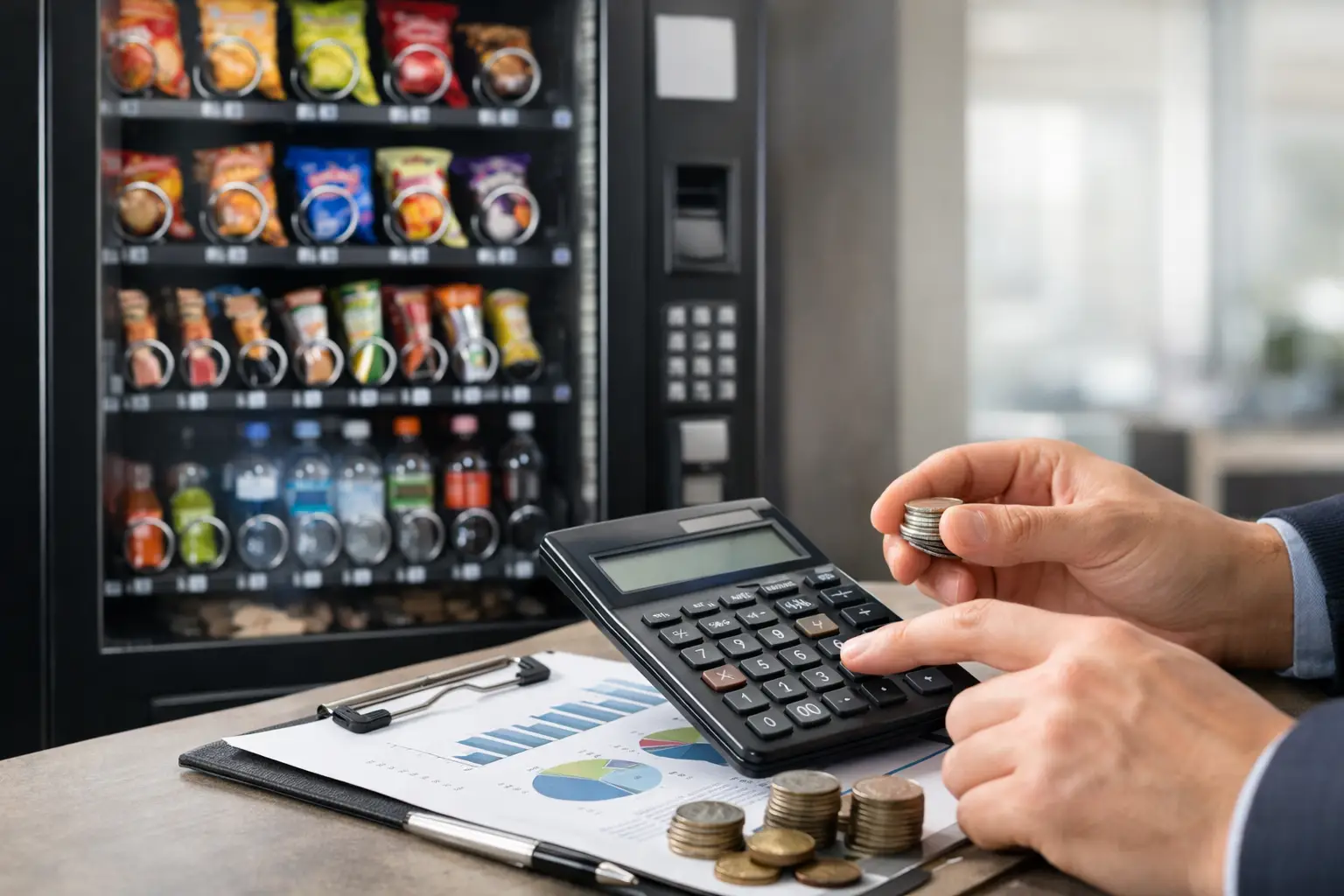
A bottled drink that sells quickly can still lose money if its price only covers the wholesale carton cost. To price vending products profitably, you need to account for every cost of putting that item in front of a customer: payment charges, delivery, machine operation, site arrangements and the risk of unsold stock. The right price is one that customers will accept while leaving enough margin to keep the machine stocked, maintained and worth operating.
For vending operators, pricing is not a one-time exercise. A gym, office tower, college or shopping centre may support different prices even for the same product. Start with a clear cost base, then test your prices against real sales data rather than relying on guesswork.
Start with the true cost per vend
Your supplier invoice price is only the beginning. Calculate the landed cost of each unit, especially when buying mixed cartons, frozen products or imported items. Include the product cost, transport or delivery charges, storage costs where relevant and any spoilage allowance.
Then add the cost of selling through the machine. Cashless payments are now expected in many locations, but card and e-wallet transactions carry processing fees. There may also be machine connectivity charges, electricity, rental or revenue-sharing arrangements with the site, and labour for replenishment. A product that costs RM2.20 to buy may have a true cost closer to RM2.70 once these operating costs are allocated.
A simple working formula is:
Selling price – true cost per item = gross profit per vend
Gross profit is not the same as net profit. It still needs to contribute towards repairs, servicing, depreciation, insurance and the time spent managing the machine. This is why pricing too close to cost can create busy machines that do not produce meaningful returns.
Set a margin that matches the product and location
There is no single ideal vending margin. Packaged snacks, canned drinks, premium coffee, fresh food and frozen meals all have different cost structures and customer expectations. A high-volume can of drink may justify a lower margin because it drives frequent transactions. A chilled protein shake, healthy meal or specialist imported snack generally needs a higher margin because it carries more stock risk and may sell more slowly.
Location matters just as much. A machine in a private staff area may need competitive everyday pricing to encourage repeat purchases. A machine in a transport hub, hospital waiting area or late-night venue may support a higher price because convenience is part of the value. Customers are not only paying for the item. They are paying for immediate access when a café, shop or canteen is unavailable.
Before setting a price, look at nearby alternatives. If a convenience shop is a short walk away and sells the same drink for less, your vending price must be close enough to feel reasonable. If your machine offers cold drinks after business hours, a modest convenience premium is usually easier to justify.
Avoid copying supermarket shelf prices
Supermarkets operate on scale, large promotional budgets and different overheads. A vending machine has a smaller product range, limited capacity and servicing requirements. Matching a supermarket price without reviewing your costs may leave too little profit for the operation to be sustainable.
Instead, use local retail prices as a reference point. Price familiar, high-volume items competitively, then protect margin on products that offer greater convenience, are less widely available or require chilled and frozen storage.
Build a product mix, not a machine full of low-margin sellers
The strongest vending range usually contains a mix of traffic drivers and margin builders. Traffic drivers are recognisable favourites such as bottled water, popular carbonated drinks, crisps and chocolate bars. They make the machine useful and give customers confidence that it is stocked with products they know.
Margin builders may include premium coffee, functional drinks, healthier snacks, chilled meals, frozen food, personal care items or location-specific products. In a gym, protein beverages and better-for-you snacks can command a sensible premium when the selection fits member needs. In an office, coffee and ready-to-eat lunches may provide stronger returns than a machine filled only with low-priced confectionery.
Do not assume a premium item is profitable simply because its selling price is high. If it expires before it sells, its margin disappears. Trial new products in a small number of selections, monitor sales and rotate poor performers quickly. Remote monitoring makes this process much easier by showing stock levels and sales patterns without unnecessary site visits.
Use price points that are easy to understand
Clear price points help customers decide quickly. In vending, complicated pricing can create hesitation, particularly on a touchscreen where customers may be choosing in seconds. Grouping everyday products into sensible bands also makes restocking and performance reviews easier.
For example, you might use one price band for standard drinks, another for premium beverages and a higher band for chilled meals. The exact figures depend on your location and costs, but the customer should be able to see why one item costs more than another.
Cashless payment changes how customers perceive price. Many buyers are less focused on carrying the exact change, which can support sensible price testing. That does not mean every item should be rounded upwards aggressively. Transparent, consistent pricing will protect repeat sales better than short-term gains from an inflated price.
Price for payment fees, site charges and service support
A vending business needs enough room in each sale to manage the machine properly. Card-enabled systems improve convenience and can increase sales, but the relevant transaction fee must be built into the calculation. Similarly, a commission paid to a property owner, gym operator or venue manager is a cost of securing that location.
Consider a product with a selling price of RM5.00. After product cost, payment fees and a share of site and operating costs, the remaining contribution may be much smaller than expected. If the machine sells only a few units a day, that contribution may not cover regular servicing and replenishment. Raising the price by a small, tested amount or replacing the product with a better-margin alternative may be the more commercial choice.
Reliable maintenance also protects pricing power. A machine with working cashless payments, clean presentation, correct temperature control and dependable product delivery gives customers a reason to buy again. A machine that frequently rejects payments or sells warm drinks damages trust, regardless of how attractive the price appears.
Test prices without disrupting customer trust
The best way to improve profitability is to make controlled changes. Adjust one product group, location or price band at a time, then compare unit sales, revenue and gross profit over several weeks. A price increase that reduces sales slightly may still improve profit. Conversely, a lower price can be worthwhile if it increases volume enough to lift total contribution.
Pay attention to dayparts and seasonal demand. Coffee may perform well in the morning, cold beverages during hot periods and ready meals around lunch or late shifts. A university location may be more price-sensitive during term time, while a corporate site may respond well to convenient premium products.
Keep an eye on customer feedback too. Complaints about price do not always mean prices are wrong, but repeated comments on a particular item deserve investigation. It may indicate that a nearby retailer has a better offer, the product is not suited to the site or the price gap between standard and premium options is too wide.
Review the machine, not just individual prices
When sales are disappointing, the answer is not automatically to reduce every price. Check whether the machine is in the right location, visible to passing customers and stocked at the right times. Review whether the product selection suits the audience and whether cashless payment options are working correctly.
A well-placed machine with the wrong mix will underperform. Equally, a strong product mix in a low-footfall corner will struggle to generate the sales needed to cover costs. Pricing works alongside location strategy, machine type, payment technology and responsive after-sales support.
KCH Vending helps operators consider these practical factors, from choosing suitable equipment and payment systems to maintaining reliable day-to-day operation. That support is particularly valuable for first-time investors who need pricing decisions to be based on realistic operating costs rather than a simple mark-up.
Set an initial price with a clear margin, watch what customers actually buy, and refine it with discipline. The goal is not to be the cheapest machine on site. It is to offer convenient, dependable value that produces a healthy return with every vend.