




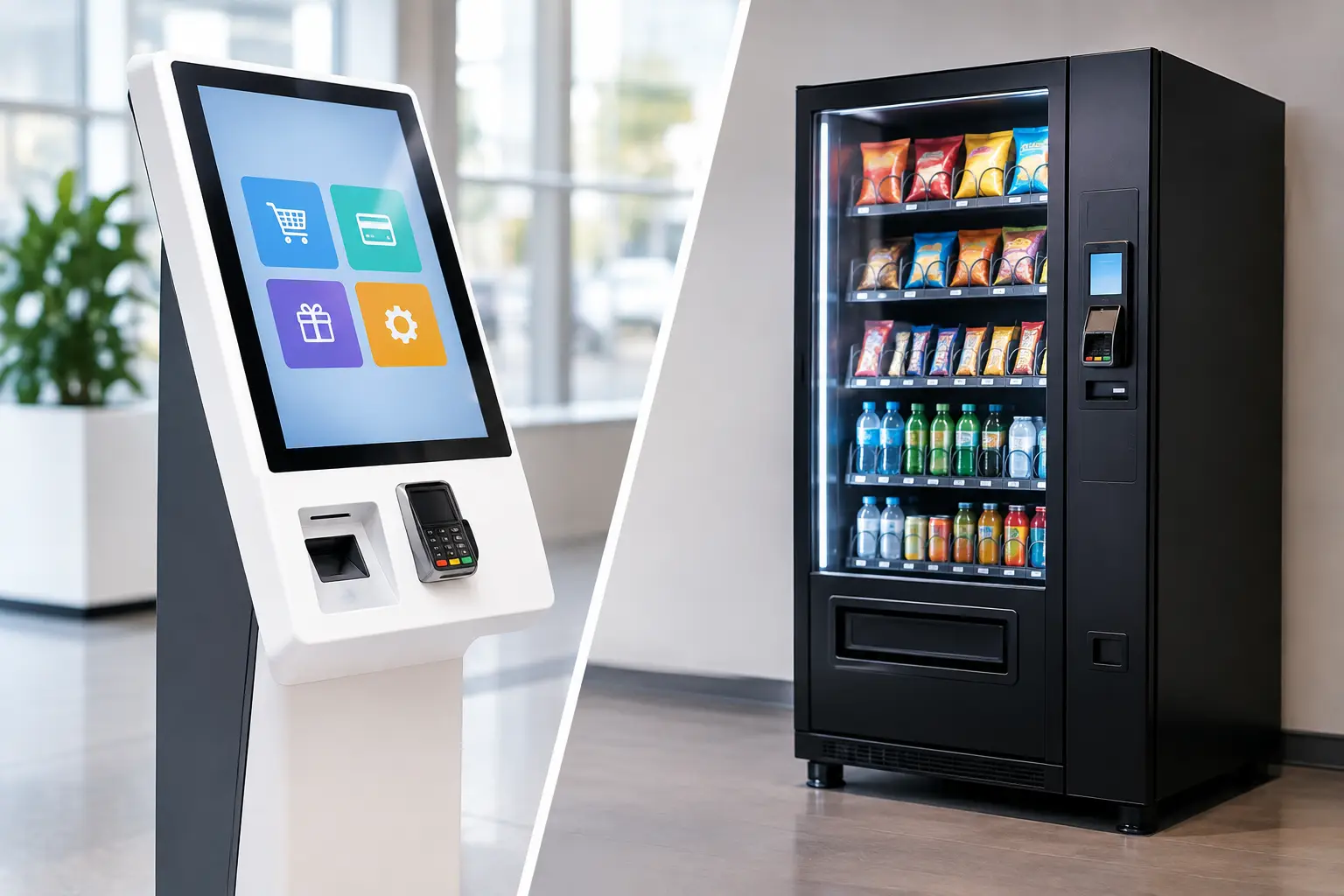
A busy gym lobby at 7am, a hospital corridor between visiting hours, or an office tower at lunchtime all create the same commercial question: how can customers buy quickly without adding staff to the counter? Cashless kiosks versus vending terminals is not simply a choice between two pieces of hardware. It affects what you can sell, how much space you need, the customer journey, and the day-to-day work required to keep the operation profitable.
For Malaysian operators, cashless acceptance is now a practical expectation rather than a premium feature. Customers want to tap a card, use an e-wallet, or pay by QR where available, then continue with their day. The right machine should make that transaction quick while giving the owner visibility, dependable technical support, and a clear route to grow.
What Is the Difference Between a Cashless Kiosk and a Vending Terminal?
A cashless kiosk is usually a larger self-service ordering or retail point with a touchscreen. It can present menus, product categories, promotional content, add-ons and product information before the customer pays electronically. Depending on the setup, the kiosk may print an order ticket, send an order to a preparation area, release access to a locker, or work as part of a micro market.
A vending terminal is more commonly the payment and selection interface attached to, or built into, a vending machine. The customer chooses a drink, snack, frozen meal, coffee or other item, pays using the enabled payment methods, and the machine dispenses the product. In some applications, a standalone terminal can also control a bank of vending lockers or several machines.
The boundary can overlap. A modern vending machine with a large touchscreen, cashless reader and remote management can feel much like a compact kiosk. The key difference is operational: a kiosk is generally designed to guide a broader order journey, while a vending terminal is designed to complete a direct unattended sale from stocked inventory.
Cashless Kiosks Versus Vending Terminals for Your Location
The better option depends on the site, the product, and the level of service expected by customers. A high-traffic location alone is not enough reason to install the biggest system. A focused machine that matches buying behaviour often earns more consistently than a complex installation with too many unused features.
When a cashless kiosk makes commercial sense
A cashless kiosk is a strong fit where customers need choice, customisation or collection instructions. A café may use one for self-ordering during peak periods, allowing staff to focus on preparation rather than queue management. A food operator may use a kiosk with heated-food collection lockers, giving customers a clear order and pickup process without crowding the counter.
Kiosks also suit micro market environments, where a broader range of packaged food, drinks and convenience products can be displayed. The screen can support product discovery, promotions and branded content, which is useful where customers spend longer browsing.
The trade-off is that a kiosk project often requires more planning. You may need integration with an ordering system, product catalogue management, a collection process, and staff workflow changes. It can offer a more tailored retail experience, but it is not always the fastest route to launch.
When a vending terminal is the better choice
A vending terminal is usually the practical choice for simple, immediate purchases. In offices, gyms, colleges, condominium common areas and factory sites, customers often know what they want. They want a cold drink after exercise, a snack during a break, or a convenient meal without waiting for a cashier.
Vending equipment also makes efficient use of space. A snack and beverage machine can operate in a narrow corridor or reception area where a kiosk-led retail setup would not be suitable. With the right cashless payment configuration, it gives customers a quick purchase path while the operator benefits from unattended sales around the clock.
For first-time vending investors, a cashless vending machine is often easier to manage. Stock can be defined clearly, product movement can be monitored, and the operation can expand machine by machine as demand is proven. This does not mean it is a passive project with no involvement. Refilling, cleaning, product selection and technical upkeep still matter. It does mean the model is straightforward to understand and replicate.
Payment Convenience Is Only One Part of the Decision
Cashless payments can increase convenience, reduce the need to handle coins and notes, and help meet customer expectations in commercial locations. However, a payment reader alone does not guarantee sales. A machine with poor product selection, weak placement or frequent downtime will still struggle.
Before choosing either format, consider the actual payment methods used by the people at your site. Card acceptance may be essential in one location, while QR-based payments may be more relevant in another. The payment setup should be compatible with your customer base and supported properly after installation.
Reliability is equally important. A failed reader at lunchtime is more than a missed transaction. It can discourage repeat use and create a poor impression of the site. Choose equipment backed by responsive maintenance, available spare parts and clear warranty coverage. Local support matters because an unattended retail machine only earns when it is working.
Product Range Changes the Right Answer
The product itself should guide the hardware decision. Standard snacks, bottled drinks, canned beverages and packaged convenience food are well suited to traditional vending machines with cashless terminals. These products are easy to display, store and dispense in a controlled way.
Coffee, hot food, frozen meals, books, beauty products and higher-value items may require more specialised vending equipment. For example, frozen food vending needs reliable temperature control, while vending lockers can provide a better collection method for bulkier products or pre-packed orders. A touchscreen interface can add value when customers need instructions, flavour choices or collection details.
A kiosk becomes more attractive as the buying decision becomes more complicated. If customers are selecting ingredients, scheduling collection, ordering multiple items or choosing from a large catalogue, a larger screen and guided journey can improve the experience. If they are buying a single isotonic drink after a workout, speed is more valuable than a detailed interface.
Operational Support Decides Long-Term Profitability
It is easy to compare purchase prices. It is more useful to compare the full operating picture: installation requirements, payment setup, stock management, remote monitoring, service response, repairs and parts availability.
Remote monitoring is particularly valuable for operators managing several sites. It can help identify sales patterns, track stock levels, monitor machine status and plan refilling routes more efficiently. Instead of visiting a location only to find a machine is still well stocked, operators can make more informed service visits. This saves time and helps reduce missed sales from empty product columns.
For property managers, dependable support protects the customer experience within the building. For business owners, it protects revenue. Ask the supplier what happens when a machine develops a fault, whether replacement parts are available, and how support is handled after commissioning. The lowest-cost machine can become expensive if downtime is lengthy or repairs are difficult to arrange.
KCH Vending supports businesses with equipment selection, cashless payment options, setup, maintenance and technical assistance, helping operators look beyond the machine specification and plan for reliable daily operation.
A Practical Way to Choose
Start with the customer moment you are trying to serve. Is it a quick grab-and-go purchase, a self-order food transaction, or a pre-order collection? Then review the available space, power and connectivity, expected daily footfall, product type and replenishment capability.
A vending terminal-led machine is usually the better starting point where purchases are fast, products are standardised and space is limited. A cashless kiosk is more suitable where the customer needs more choice, ordering guidance or a connected collection process. Some sites benefit from both: a vending bank for instant purchases and a kiosk or locker system for made-to-order food.
Do not select based on screen size alone. Select the setup that customers will use without hesitation and your team can maintain without disruption. The most profitable unattended retail solution is often the one that makes buying feel simple, keeps products available, and has dependable support ready when the site needs it.