




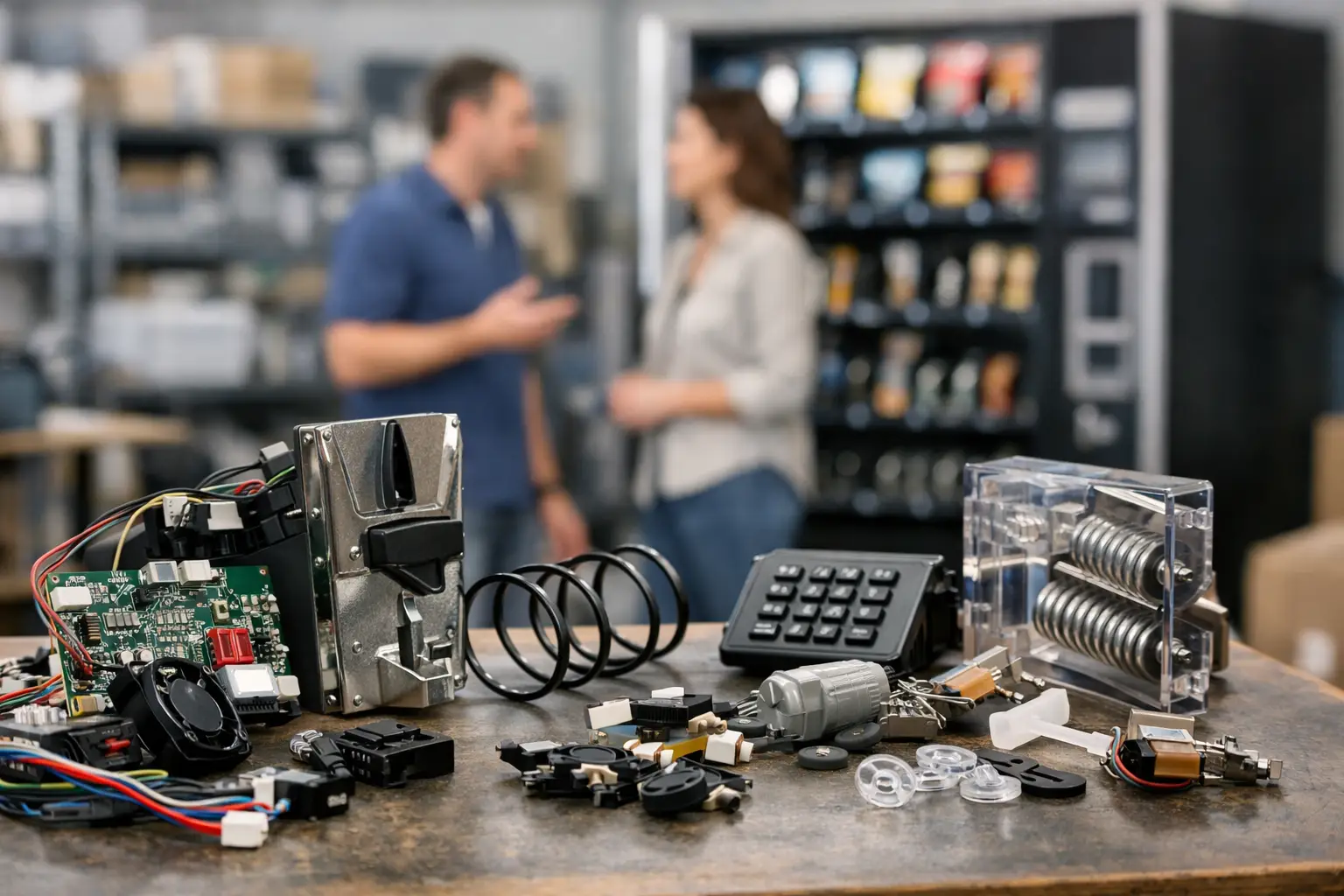
A vending machine can be in a prime location, stocked with the right products, and fitted with cashless payment – but if a coin mech fails, a motor jams, or a cooling part gives way, revenue stops immediately. That is why choosing the right vending machine spare parts supplier matters far more than many operators expect. Parts supply is not just a maintenance issue. It is a business continuity issue.
For business owners, property managers, and first-time vending investors, the real question is simple: when something goes wrong, how quickly can you get the machine working again? A supplier that can provide the right part, the right guidance, and the right after-sales support helps protect sales, customer trust, and the long-term return on your machine.
Why a vending machine spare parts supplier matters
In vending, downtime has a direct cost. If a snack machine in a gym is out of action for three days, those missed sales are gone. If a coffee machine in an office tower keeps rejecting payments because a component is faulty, users stop relying on it. Small faults quickly become bigger commercial problems when parts are slow to source.
A dependable vending machine spare parts supplier helps avoid that situation. The value is not only in having stock on hand. It is also in knowing which part is compatible, whether the issue is mechanical or electronic, and whether the replacement will solve the fault or simply mask it for a short period.
This is especially important for operators managing more than one machine type. A frozen food machine, a hot beverage machine, and a touchscreen snack machine each have different wear points, service cycles, and technical requirements. A general parts trader may be able to quote on components, but a specialist supplier is more likely to understand how those components affect day-to-day operation.
What to look for in a spare parts supplier
The first requirement is compatibility. Not all vending machines use interchangeable components, and buying the wrong part can waste both time and money. Motors, spirals, control boards, payment modules, refrigeration parts, sensors, and display elements vary by make and model. A suitable supplier should be able to identify the correct part quickly and accurately.
The second requirement is response time. In practice, a supplier is judged less by what they promise and more by how fast they can act when a machine is down. If parts are available locally, service interruptions are usually shorter. If every item has to be ordered in from overseas, repairs may stretch from days into weeks. For a busy commercial site, that delay can hurt more than the cost of the part itself.
Technical support also matters. Some operators have in-house maintenance capability, while others rely entirely on external help. A strong supplier should be able to do more than hand over a component number. They should help troubleshoot the fault, confirm whether a part is actually needed, and advise when a technician visit makes more sense than a self-repair attempt.
Warranty and after-sales coverage are another practical factor. Some parts fail because of age and usage. Others fail because of installation issues, electrical instability, or environmental conditions. A supplier that stands behind its parts and service gives buyers more confidence, particularly those new to vending.
The difference between buying parts and buying support
There is a real difference between sourcing a spare part and securing operational support. On paper, the cheapest supplier can look attractive. In reality, low-cost parts can become expensive if they are poor quality, incompatible, or late.
For example, replacing a payment device with a non-matching unit may create software communication issues. Installing a lower-grade cooling component in a chilled machine may reduce performance and shorten product shelf life. In both cases, the part may fit physically, yet still create a bigger operating problem.
That is why many commercial buyers prefer a full-service partner rather than a parts-only seller. When the same provider supports machine supply, maintenance, and spare parts, diagnosis is often faster and accountability is clearer. There is less guesswork, fewer handovers, and a better chance of getting the machine back into service promptly.
Common spare parts that affect machine uptime
Some parts fail more often than others because they handle repeated daily use. Payment system components are a frequent source of service calls, particularly in high-traffic locations. Coin mechanisms, note validators, card readers, and related communication modules all need to work reliably if sales are to continue without friction.
Dispensing parts are another major category. Motors, spirals, belts, and sensors can wear over time, especially in snack and combo machines. A machine that accepts payment but does not vend correctly causes instant frustration and often leads to refund requests or site complaints.
In chilled, frozen, and hot food machines, temperature-related components are critical. Compressors, fans, thermostats, heaters, and control elements need proper maintenance and timely replacement. If these parts fail, the issue is not only downtime but also product quality and safety.
Touchscreens, mainboards, wiring components, locks, and door seals are also easy to overlook until they become urgent. A supplier with broad parts coverage is often more useful than one that only carries a narrow range of common items.
Local supply makes a commercial difference
For operators in Malaysia, local coverage can make repairs far more manageable. A vending machine spare parts supplier with local service capability is usually better placed to respond quickly, coordinate technical checks, and reduce waiting time for replacements.
This matters even more for businesses running machines across different premises. A shopping centre, university, office building, or gym chain cannot afford a long queue of unresolved faults. Fast local support helps standardise maintenance and keeps revenue channels active.
There is also a practical communication benefit. When a supplier understands the local operating environment, site conditions, and common machine use cases, advice tends to be more relevant. Issues such as humidity, traffic volume, product type, and payment preferences can all affect part selection and maintenance planning.
When first-time buyers should think about spare parts
Many new vending investors focus on machine type, product mix, and placement first. Those are all important, but parts support should be part of the buying decision from the start. A machine is only as profitable as its ability to stay in service.
Before committing, ask what spare parts are typically stocked, how faults are handled, whether remote diagnosis is available, and what the expected turnaround is for common repairs. It is also worth asking which components are considered wear-and-tear items and how often they usually need replacing.
This does not mean every buyer needs to hold a shelf full of stock. In many cases, keeping a small number of critical parts on hand is enough, especially for operators with several identical machines. The right approach depends on machine volume, site importance, and whether quick technician access is available.
A smarter way to protect vending profitability
A profitable vending operation depends on more than product margins. Reliability, service speed, and technical backup all shape the actual return. If one machine is out of action repeatedly, the location can lose confidence. If several machines are affected, the whole investment starts to feel harder to manage.
That is why experienced operators often choose suppliers who can support the full lifecycle of the machine. Parts availability, repairs, maintenance, payment support, and practical troubleshooting all work together. KCH Vending follows that service model because commercial buyers do not just need equipment – they need dependable operation after installation as well.
The best supplier for your business is not always the one with the lowest parts price. It is the one that helps you reduce downtime, protect sales, and make everyday machine management simpler. If your vending machine is part of a revenue plan, spare parts supply should be treated with the same seriousness as machine selection and site strategy.
A good machine in the wrong support system can still become a poor investment. A good machine backed by fast parts access and responsive service has a much better chance of staying profitable where it matters most – on site, in use, and earning every day.